

Real estate has always been a popular investment option in India. Many people invest in residential plots, apartments, and commercial properties to earn rental income or benefit from rising property prices. However, buying a property requires a large amount of money and involves additional expenses such as registration fees, maintenance costs, property taxes, and legal charges.
What if you could invest in large commercial properties, shopping malls, and office buildings without buying an entire property?
This is where Real Estate Investment Trusts (REITs) come into the picture.
REITs allow ordinary investors to participate in income-generating real estate through investments in listed units. They provide an alternative for people who want exposure to the real estate market without directly purchasing and managing physical property.
In this article, we will explain what REITs are, how they work, how to invest in them in India, their benefits and risks, and what beginners should consider before investing.
1. What Is a Real Estate Investment Trust (REIT)?
A Real Estate Investment Trust is an investment vehicle that pools money from multiple investors and invests it in real estate assets that generate income.
These assets may include:
- 🏢 Commercial office buildings
- 🛍️ Shopping malls and retail centres
- 🏬 Business parks
- 🏨 Certain hospitality-related properties
- 🏙️ Other eligible real estate assets
The properties are leased to businesses and tenants. The rental income, after applicable expenses, can contribute to the income distributed to investors.
REITs in India are regulated by the Securities and Exchange Board of India (SEBI). Their units are listed on stock exchanges and can generally be purchased or sold through a stockbroker, much like shares.
How does a REIT work?
Imagine a company owns several large office buildings in Bengaluru, Chennai, Hyderabad, and Mumbai. Instead of requiring one investor to purchase an entire building, the REIT pools money from many investors to own and manage a portfolio of properties.
The tenants pay rent to occupy these buildings. After expenses and other applicable payments, the REIT distributes eligible cash flows to its investors.
Simple example:
An investor purchases REIT units worth ₹10,000. The investor then owns units representing a small financial interest in the REIT, rather than directly owning a specific office or apartment.
If the REIT makes distributions, the investor may receive a share according to the units held and the distribution declared. If the market price of the units increases, the investor may also earn a capital gain by selling them at a higher price.
However, neither distributions nor capital appreciation are guaranteed.
2. How Does REIT Investment Work?
The basic process can be understood in five steps:
Investor → Buys REIT units → REIT owns income-generating properties → Tenants pay rent → Eligible income is distributed to investors
The investor does not need to find tenants, collect rent, arrange building maintenance, or manage the properties personally.
The REIT's professional management team handles the portfolio, subject to the applicable regulations and trust arrangements.
Where does the investor's return come from?
There are two main sources of potential returns:
1. Income distributions
The REIT may distribute eligible income or cash flows to unit holders. Depending on the REIT's structure and the nature of its income, payments may include interest, dividends, rental-related income, or other components.
2. Capital appreciation
If demand for the REIT increases or the market value of its underlying assets improves, the price of its units may rise. Investors may make a profit by selling units for more than their purchase price.
The unit price can also fall, so investors may incur losses.
3. How to Invest in REITs in India
Investing in listed REITs is relatively straightforward. Beginners can follow these steps.
Step 1: Open a Demat and Trading Account
You generally need a Demat account and a trading account with a registered stockbroker to buy listed REIT units.
A Demat account holds your securities electronically, while a trading account allows you to place buy and sell orders.
If you already invest in shares, you may be able to use your existing accounts.
Before choosing a broker, check its charges, platform features, customer support, and regulatory registration.
Step 2: Research the Available REITs
Do not select a REIT based only on its unit price or the most recently announced distribution.
Study the properties it owns, the quality of its tenants, rental income, occupancy levels, debt, management quality, and historical performance.
Consider whether the REIT mainly focuses on office buildings, shopping centres, or a combination of eligible real estate assets.
Different REITs have different business models and risks.
Step 3: Check the Unit Price and Financial Information
Before investing, review the REIT's latest investor presentation, financial results, annual report, distribution announcements, and net asset value (NAV) information.
Also examine the relationship between the market price and the REIT's reported asset value. A unit trading below NAV is not automatically a bargain, and a unit trading above NAV is not automatically overpriced.
Compare the valuation with the quality and growth potential of the underlying properties.
Step 4: Buy REIT Units Through Your Broker
Log in to your trading platform and search for the REIT by its name or exchange ticker.
Review the displayed price, available quantity, bid-ask spread, and applicable charges before placing an order.
You can usually place a limit order to specify the maximum price you are willing to pay.
The minimum investment depends on the market price, applicable trading rules, and any offer-specific requirements. You do not necessarily need to purchase an entire property or invest lakhs of rupees.
Step 5: Monitor Your Investment
After buying the units, monitor the REIT's quarterly financial results, occupancy levels, rental growth, debt position, distributions, and market price.
Review whether the investment continues to meet your financial goals. Avoid making decisions based only on daily price movements.
You can generally sell listed units through your broker during exchange trading hours, subject to market liquidity and applicable rules.
4. Which REITs Are Available in India?
As of June 30, 2026, the Indian REIT market had six listed REITs, according to the Indian REITs Association.
Some well-known examples are:
- Embassy Office Parks REIT: Primarily associated with large commercial office parks.
- Mindspace Business Parks REIT: Focuses on commercial office properties and business parks.
- Brookfield India Real Estate Trust: Provides exposure to a portfolio of commercial real estate assets.
- Nexus Select Trust: Primarily focuses on shopping malls and retail-led consumption centres.
- Knowledge Realty Trust: Provides exposure to commercial real estate, including office assets.
- Bagmane Prime Office REIT: Focuses on office-oriented commercial real estate.
These examples are provided for educational purposes, not as a ranking or recommendation. Their portfolios, financial performance, valuations, and risks differ.
Before investing, verify the latest listing information and official disclosures through the relevant stock exchange and the REIT's investor relations website.
5. How Much Money Do You Need to Invest?
One of the biggest advantages of REITs is that you can invest in real estate without paying the full cost of buying a property.
For example, purchasing an apartment may require several lakhs of rupees as a down payment, apart from registration and other costs. By comparison, listed REIT units can provide access to real estate exposure with a much smaller investment.
Consider this simple illustration:
Investment amountWhat it represents₹5,000A small initial investment, if permitted by the unit price₹10,000An illustrative starter investment₹25,000A larger initial allocation₹50,000A higher allocation to REIT units
These amounts are examples, not minimum investment requirements or recommendations. The number of units you can buy depends on the current market price and trading rules.
For beginners, starting with an amount they can afford to keep invested is generally more sensible than committing a large sum immediately.
6. How Can You Earn Money from REITs?
Suppose you invest ₹20,000 in a REIT.
For illustration, assume the investment generates an annual distribution equivalent to 6% of your initial investment. This is a hypothetical rate, not a forecast or a return offered by any specific REIT.
Your estimated annual distribution would be:
₹20,000 × 6% = ₹1,200
This is equivalent to ₹100 per month on average, although actual distributions may occur quarterly or at other intervals and are not necessarily equal.
Now consider the unit price.
If your units increase in market value by 8%, your investment's market value would rise from ₹20,000 to ₹21,600. The ₹1,600 increase is an unrealised gain until you sell the units.
If the unit price falls by 8%, the investment's market value would decline to ₹18,400.
Your overall return depends on distributions received, changes in unit price, costs, and taxes.
Important: A distribution yield is not the same as a guaranteed interest rate. A high yield may reflect higher risk or a falling unit price, so it should not be the only factor in your decision.
7. Advantages of Investing in REITs
1. Lower entry cost
You can gain exposure to large commercial properties without purchasing an entire building or apartment.
2. Potential income
Rental income from tenants can support distributions to unit holders, although the amount and timing may vary.
3. Professional property management
Property operations, leasing, and maintenance are handled by the REIT and its appointed managers rather than by each investor.
4. Diversification
A REIT may hold multiple properties, tenants, or locations. This can reduce dependence on a single property, although the level of diversification varies between REITs.
5. Easier buying and selling
Listed REIT units can generally be traded through stock exchanges. This is often more convenient than selling physical property, though liquidity and the selling price are not guaranteed.
6. Access to commercial real estate
Investors can participate financially in eligible commercial real estate assets that may otherwise be difficult to access individually.
8. Risks You Should Understand Before Investing
REITs have several advantages, but they are not risk-free.
Market risk: Unit prices can fluctuate with interest rates, investor sentiment, and broader stock-market conditions.
Occupancy risk: If tenants leave or buildings remain vacant, rental income may decline.
Interest-rate risk: Higher borrowing costs can affect REIT finances and may make competing income-generating investments more attractive.
Tenant concentration risk: A REIT that depends heavily on a small number of tenants may be more vulnerable if one of them leaves or fails to pay rent.
Debt risk: High borrowing levels can increase financial pressure, especially when interest costs rise or refinancing becomes difficult.
Distribution risk: Payments can change depending on operating performance, expenses, debt obligations, and the composition of distributable cash flows.
Liquidity risk: Some REIT units may trade less frequently than others. You may not be able to sell quickly at the price you want.
Invest only after considering these risks and your ability to tolerate fluctuations in investment value.
9. Taxation of REIT Investments in India
Taxation is an important factor to consider before investing in REITs.
Unlike a simple bank deposit, REIT distributions can contain different types of income. Depending on the REIT's income and the applicable tax rules, distributions may include interest, dividends, rental-related income, or other components.
These components may receive different tax treatment in the hands of investors.
Capital gains from selling REIT units may also be taxable. The applicable treatment depends on factors such as the type of transaction, holding period, and tax rules in force at the time of sale.
Before investing, remember these points:
- Check the tax breakdown provided with the REIT's distribution announcement.
- Review any applicable tax deducted at source (TDS).
- Keep records of purchase prices, distributions, and sale transactions.
- Consult a qualified tax professional if you need help calculating your actual tax liability.
Tax rules can change, so verify the current requirements before making investment decisions.
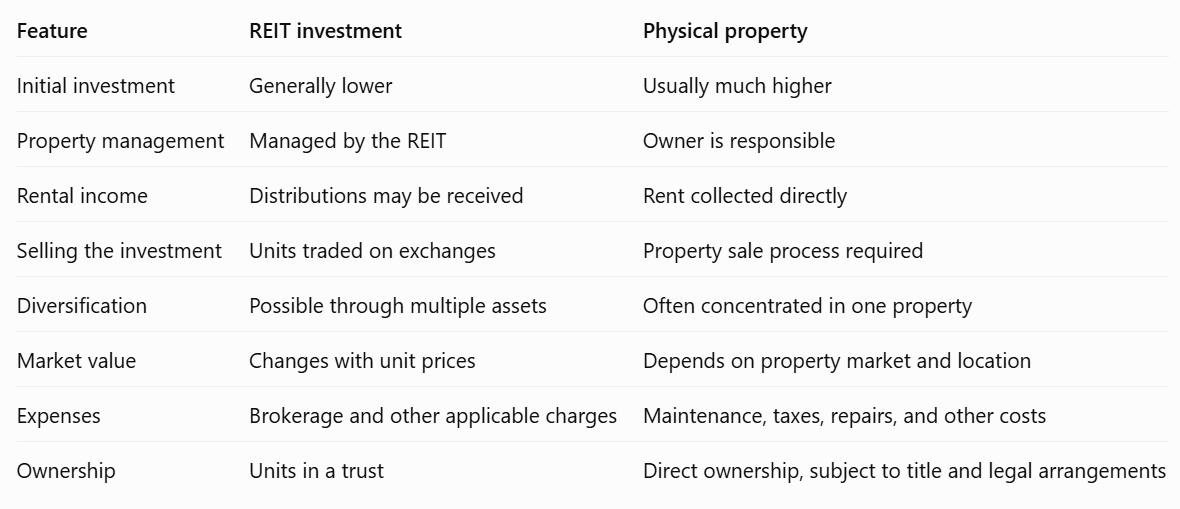
10. REITs vs. Physical Property Investment
Many investors wonder whether it is better to buy a physical property or invest in a REIT. The answer depends on their budget, goals, and willingness to manage property.
Which is better?
REITs may suit investors who want real estate exposure without managing buildings or committing a large amount of money to a single property.
Physical property may suit people who want direct ownership, personal use, or control over a particular asset.
Both options have their own advantages, costs, and risks.
11. Practical Checklist for First-Time REIT Investors
Before investing, use this simple checklist:
- ✅ Open a Demat and trading account with a registered broker.
- ✅ Understand the REIT's property portfolio and business model.
- ✅ Check occupancy levels, tenant quality, and lease arrangements.
- ✅ Review rental income, debt, and interest expenses.
- ✅ Compare the unit price with NAV and other valuation measures.
- ✅ Study the history and composition of distributions.
- ✅ Understand applicable taxes and transaction charges.
- ✅ Invest only an amount that fits your financial goals and risk tolerance.
- ✅ Diversify rather than putting all your savings into one REIT.
- ✅ Review official disclosures periodically.
Conclusion
Real Estate Investment Trusts offer Indian investors another way to participate in the real estate market without buying and managing physical property.
They can provide access to commercial offices, shopping centres, and other income-generating assets through listed units. Investors may benefit from distributions and potential capital appreciation, but returns are not guaranteed and market prices can fall.
For beginners, the best approach is to understand how REITs work, compare the available options, review financial information, and start with an affordable investment amount.
The key is to invest based on research, not simply because a REIT advertises a high distribution yield. Consider REITs as one possible part of a diversified investment portfolio rather than a guaranteed source of income.
Disclaimer: This article is for educational purposes only and does not constitute financial, investment, or tax advice. Investments in REITs are subject to market risks. Please read the relevant disclosures and consult a qualified financial adviser before investing.