

Real estate has always been considered an attractive investment option in India. Traditionally, people invest in residential properties, commercial buildings, land, or Real Estate Investment Trusts (REITs) to earn rental income and benefit from property value appreciation.
However, there is another investment option that is gradually gaining attention among high-net-worth individuals (HNIs) and sophisticated investors: Real Estate Alternative Investment Funds (AIFs).
Real Estate AIFs allow investors to pool their money with other investors and participate in large real estate projects without directly purchasing an entire property.
These funds are managed by professional fund managers who identify investment opportunities, manage projects, and aim to generate returns for investors.
In this article, we will understand how Real Estate AIFs work in India, their different categories, minimum investment requirements, liquidity, and the risks investors should consider before investing.
1. What are Real Estate Alternative Investment Funds (AIFs) in India?
An Alternative Investment Fund (AIF) is a privately pooled investment vehicle that collects money from investors and invests it according to a predefined investment strategy.
In India, AIFs are regulated by the Securities and Exchange Board of India (SEBI) under the SEBI (Alternative Investment Funds) Regulations, 2012.
A Real Estate AIF is an investment fund that focuses on opportunities in the real estate sector.
Instead of purchasing a property individually, investors contribute money to a common fund. The fund manager uses this money to invest in real estate-related opportunities.
These investments may include:
- Residential housing projects.
- Commercial office buildings.
- Shopping malls and retail properties.
- Warehouses and logistics parks.
- Real estate development projects.
- Real estate companies and Special Purpose Vehicles (SPVs).
- Real estate-backed financing opportunities.
How does a Real Estate AIF work?
Let us understand with a simple example.
Suppose a real estate developer plans to develop a commercial building in Bangalore. The total project investment required is ₹100 crore.
Instead of raising the entire amount from one investor, the developer may approach an investment fund.
The fund manager creates a real estate investment opportunity and collects money from multiple eligible investors.
For example:
- Investor A contributes ₹2 crore.
- Investor B contributes ₹3 crore.
- Investor C contributes ₹5 crore.
- Other investors contribute the remaining amount.
The fund collects the required capital and invests in the project through an appropriate investment structure.
After the commercial building is developed and leased to tenants, the project may generate rental income and potentially increase in value.
The fund may distribute income or investment proceeds to investors according to its investment strategy and fund documents.
Simple illustration:
Investors → Real Estate AIF → Fund Manager → Real Estate Project → Income / Capital Gains → Investors
The actual investment structure, income distribution, and return expectations depend on the fund's strategy and legal agreements.
2. How do AIFs differ from other real estate-related investments?
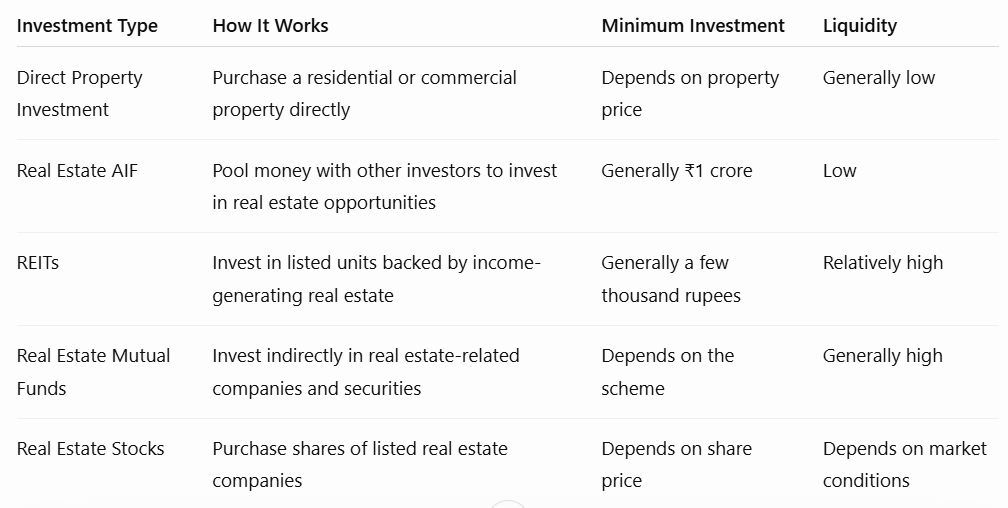
Investors in India have several options to participate in the real estate market. Real Estate AIFs are different from traditional property investments and REITs.
Let us compare the major investment options.
A. Direct Property Investment
In direct property investment, an individual purchases a house, apartment, plot, or commercial property.
The investor owns the property and can earn rental income or sell it to generate capital gains.
Example: Purchasing an apartment in Chennai for ₹60 lakh and renting it out.
Key difference: The investor directly owns the property and is responsible for maintenance, tenants, legal documentation, and other property-related activities.
B. Real Estate AIFs
In Real Estate AIFs, investors contribute money to a professionally managed investment fund.
The fund invests in selected real estate projects or companies.
Example: Investing ₹1 crore in a real estate fund that finances multiple commercial development projects.
Key difference: Investors generally own units in the fund rather than directly owning the underlying properties.
C. Real Estate Investment Trusts (REITs)
REITs allow investors to participate in income-generating real estate through listed investment units.
These trusts typically own and operate commercial properties such as office buildings, shopping centres, and other income-generating assets.
Investors can purchase and sell listed REIT units through stock exchanges.
Key difference: REITs generally provide better liquidity and lower entry requirements compared with Real Estate AIFs.
D. Real Estate Stocks
Investors can also purchase shares of publicly listed real estate companies.
These companies may develop residential projects, commercial buildings, or other real estate assets.
Key difference: Investors own shares in a real estate company rather than units in a dedicated real estate investment fund.
3. What is the difference between Category I AIFs and Category II AIFs?
Under SEBI regulations, Alternative Investment Funds are classified into three categories:
- Category I AIF
- Category II AIF
- Category III AIF
For understanding Real Estate AIFs, Category I and Category II are particularly important.
Category I AIF
Category I AIFs generally invest in businesses and sectors that are considered economically or socially desirable.
These funds include:
- Venture Capital Funds
- SME Funds
- Social Venture Funds
- Infrastructure Funds
Infrastructure-focused funds may invest in eligible infrastructure-related real estate and development opportunities.
Category II AIF
Category II AIFs include funds that do not fall under Category I or Category III.
These funds generally invest in private equity, private credit, and other permitted investment opportunities.
Real estate funds are commonly structured as Category II AIFs, particularly when they invest in real estate development projects, real estate companies, or project-level SPVs.
Comparison: Category I vs Category II
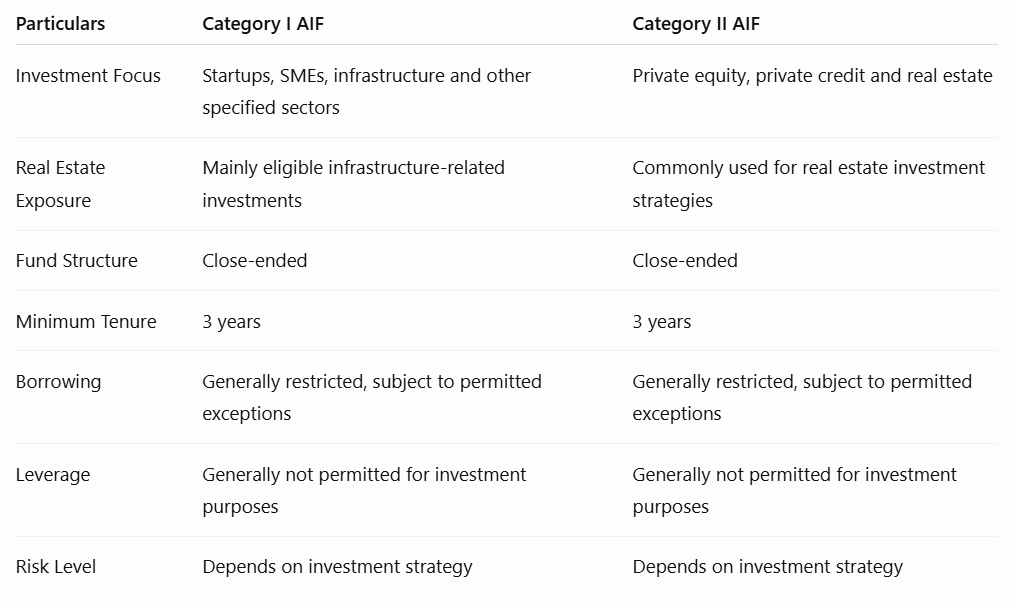
Important: Category I and Category II AIFs are both subject to SEBI regulations. However, their investment objectives and permitted investment activities are different.
Category III AIFs, on the other hand, may use more complex investment strategies, including permitted leverage and derivatives.
4. Minimum Investment, Tenure, Liquidity and Concentration Limits
Before investing in a Real Estate AIF, investors should understand four important factors.
A. Minimum Investment
Under the general SEBI AIF framework, the minimum investment amount for an investor is ₹1 crore.
There are certain exceptions:
- Employees or directors of the AIF or its manager may invest with a minimum of ₹25 lakh.
- Accredited investors are exempt from the general ₹1 crore minimum investment requirement, subject to applicable SEBI conditions.
- Certain specialised schemes have separate requirements.
Therefore, Real Estate AIFs are generally designed for high-net-worth individuals, institutional investors, and sophisticated investors rather than ordinary retail investors.
B. Investment Tenure
Category I and Category II AIFs are generally close-ended investment funds.
This means investors are expected to remain invested until the fund completes its investment cycle.
Under SEBI regulations:
- The minimum tenure is three years.
- The actual tenure is determined by the fund.
- An extension of up to two years may be permitted with approval from investors representing two-thirds of the investment value.
- Certain accredited-investor-only fund structures have additional flexibility.
For example, a Real Estate AIF may have a tenure of seven years.
During this period, the fund manager may acquire assets, finance projects, manage investments, and eventually exit the investments to return capital to investors.
C. Liquidity
Liquidity refers to how easily an investor can convert an investment into cash.
Real Estate AIFs generally have limited liquidity because their underlying investments may involve long-term property development projects and privately held assets.
Investors should understand the following:
- Early withdrawal may not be permitted.
- Finding a buyer for AIF units may be difficult.
- Selling units may require compliance with fund documentation and applicable regulations.
- Returns may be distributed only when the underlying investments generate income or are successfully exited.
Although SEBI regulations permit listing of units of close-ended AIFs after the final close, listing does not guarantee an active market or easy liquidity.
D. Concentration Limit
Concentration limits are designed to reduce the risk of investing too much money in a single investment.
Under the general SEBI framework, Category I and Category II AIFs cannot invest more than 25% of their investable funds in a single investee company, subject to applicable exceptions and regulatory conditions.
Example:
Suppose a Real Estate AIF has investable funds of ₹100 crore.
Under the general concentration rule, the fund cannot invest more than ₹25 crore in one investee company.
This helps reduce the risk associated with excessive exposure to a single company.
Important: This is an investee-company concentration limit, not necessarily a direct limit on the value of every individual property held by a fund. The applicable investment structure and SEBI provisions should be examined separately.
5. Key Risks and Considerations Before Investing in Real Estate AIFs
Although Real Estate AIFs provide opportunities to participate in large property projects, they also involve certain risks.
Investors should carefully evaluate the following factors.
A. Market Risk
Real estate prices depend on economic conditions, interest rates, demand, infrastructure development, and location.
If property prices decline, the value of the fund's investments may also decrease.
B. Liquidity Risk
Unlike listed REITs, Real Estate AIFs generally do not offer easy entry and exit opportunities.
Investors may not be able to withdraw their money whenever they need it.
C. Project Completion Risk
Real estate development projects may experience delays due to construction problems, regulatory approvals, land disputes, or funding shortages.
Such delays can affect the expected returns and investment tenure.
D. Developer and Management Risk
The performance of a Real Estate AIF depends significantly on the fund manager and the developers involved in the projects.
Poor project selection, weak financial management, or inexperienced developers may result in losses.
E. Regulatory and Legal Risk
Real estate projects must comply with applicable regulations, including RERA requirements, land-use permissions, environmental approvals, and other local laws.
Any legal disputes or regulatory issues may affect the project's progress and profitability.
F. Concentration Risk
If a fund invests heavily in a particular city, developer, property type, or project, its performance may be affected by problems in that specific market.
Investors should examine the fund's diversification strategy.
G. Return and Valuation Risk
Real Estate AIF returns are not guaranteed.
The actual returns may be lower than the projected returns because of changes in property values, rental income, project costs, financing expenses, and exit conditions.
Investors should also understand how the fund values its unlisted or privately held investments.
H. Fees and Expenses
AIF investments may involve several charges, such as:
- Management fees
- Performance fees or carried interest
- Administrative expenses
- Legal and transaction costs
- Other fund-related expenses
These charges can reduce the final returns received by investors.
Important Checks Before Investing
Before investing in any Real Estate AIF, investors should:
- Verify the fund's SEBI registration.
- Understand the investment strategy and fund structure.
- Review the Private Placement Memorandum (PPM).
- Check the fund manager's experience and previous performance.
- Understand the investment tenure and exit strategy.
- Review management fees and other expenses.
- Examine the underlying projects and their legal approvals.
- Understand the risks and possible capital losses.
Conclusion
Real Estate Alternative Investment Funds offer investors another way to participate in India's growing real estate market without directly purchasing and managing properties.
They provide access to professionally managed investment opportunities, including residential development, commercial real estate, infrastructure-related projects, and real estate financing.
However, these funds are generally suitable for investors who can commit substantial capital for a longer period and are comfortable with relatively higher investment risks and limited liquidity.
Before making an investment decision, investors should carefully understand the fund's structure, investment strategy, management team, fees, tenure, and associated risks.
The most important point is that Real Estate AIFs should be evaluated as long-term, relatively illiquid investments rather than as substitutes for traditional savings products or easily tradable REITs.
Disclaimer
This article is intended for general educational and informational purposes only. It does not constitute investment advice, financial advice, or a recommendation to invest in any particular Alternative Investment Fund. Real Estate AIF investments involve market, liquidity, regulatory, and project-related risks, and returns are not guaranteed. Investors should carefully review the relevant fund documents and consult a qualified financial advisor before making any investment decision.