
Buying a house or investing in property is one of the most important financial decisions in a person's life. However, property buyers may sometimes face challenges such as delayed project completion, misleading advertisements, unclear property details and unexpected changes in project specifications.
To protect homebuyers and bring more transparency to the real estate industry, the Government of India introduced the Real Estate (Regulation and Development) Act, 2016, commonly known as RERA.
RERA helps regulate the real estate sector by establishing rules for builders, developers and real estate agents. It also provides a mechanism through which property buyers can raise complaints and seek appropriate remedies.
In this article, we will understand what RERA is, why it was introduced, its major purposes and the state-wise RERA portals available in India.
1. What is RERA?
RERA stands for Real Estate (Regulation and Development) Act, 2016.
It is an Indian law introduced to regulate the real estate industry and protect the interests of property buyers. The Act was passed by Parliament in March 2016, and its major provisions came into force on May 1, 2017.
Under this law, every state and Union Territory is required to establish a Real Estate Regulatory Authority (or designate an existing authority) to monitor and regulate applicable real estate projects and transactions.
RERA aims to create a more transparent and accountable relationship between property buyers and builders.
Simple example:
Suppose you purchase an apartment in a residential project that is advertised as being completed by December 2027.
- The builder must provide the applicable project details and proposed completion date.
- The project must be registered with the respective RERA authority if it falls within the registration requirements.
- The builder must comply with the approved plans and applicable RERA requirements.
- If the builder fails to meet legal obligations, buyers may approach the relevant RERA authority for relief.
2. What is the Purpose of RERA?
The main purpose of RERA is to make the real estate sector more transparent, accountable and buyer-friendly.
Before RERA, property buyers often faced problems such as project delays, misleading advertisements, changes in construction plans and difficulties in obtaining refunds.
RERA was introduced to address these challenges and improve confidence in the real estate market.
The major purposes of RERA are explained below.
2.1 Protecting Property Buyers
RERA protects homebuyers by establishing legal responsibilities for builders and developers. It provides buyers with a regulatory mechanism to raise complaints when developers fail to fulfil their obligations.
2.2 Ensuring Transparency
Builders are required to disclose important project information, including:
- Project approval details.
- Approved building plans and layout plans.
- Project completion timelines.
- Carpet area of apartments.
- Construction progress and other prescribed information.
This allows buyers to make more informed property purchase decisions.
2.3 Reducing Project Delays
RERA makes developers accountable for completing registered projects within the declared timelines, subject to applicable legal provisions.
If a developer fails to complete or hand over possession as agreed, buyers may be entitled to interest, compensation or a refund, depending on the circumstances and applicable provisions.
2.4 Preventing Misleading Advertisements
Developers must provide accurate information about registered projects. They cannot freely advertise or market a project without complying with applicable RERA registration requirements.
This helps reduce misleading property advertisements and false promises.
2.5 Maintaining Financial Accountability
Under Section 4(2)(l)(D) of the RERA Act, developers must deposit 70% of the amounts realised from allottees and financial institutions for a real estate project into a separate account in a scheduled bank.
The funds must be used for the land and construction costs of that project, subject to the Act's withdrawal and certification requirements.
2.6 Providing a Complaint Redressal Mechanism
If a buyer experiences problems with a builder or developer, they can file a complaint before the appropriate RERA authority.
The authority can examine complaints and pass orders within its legal powers. Appeals may also be made to the Real Estate Appellate Tribunal, where applicable.
3. State-Wise RERA Portals in India
The Real Estate Regulatory Authority operates through state and Union Territory-level regulatory arrangements. Each authority provides information about registered real estate projects, promoters, agents, regulations and complaint procedures.
If you are planning to purchase a property, you should visit the RERA portal applicable to the location of the property.
For example, if you are purchasing an apartment in Coimbatore, Tamil Nadu, you should check the Tamil Nadu RERA portal rather than the portal of another state.
The following directory contains 25 state/UT entries published in the Ministry of Housing and Urban Affairs' RERA portal directory, arranged in alphabetical order.
State and Union Territory RERA portal directory
1. Andaman and Nicobar Islands – RERA Portal
Tamil Nadu RERA Portal (linked authority portal)
2. Andhra Pradesh Real Estate Regulatory Authority (APRERA)
3. Assam Real Estate Regulatory Authority (RERA Assam)
4. Bihar Real Estate Regulatory Authority (BRERA)
5. Chhattisgarh Real Estate Regulatory Authority (CG RERA)
6. Dadra and Nagar Haveli and Daman and Diu – RERA Portal
MahaRERA Portal (linked authority portal)
7. Delhi Real Estate Regulatory Authority (Delhi RERA)
Real Estate Regulatory Authority For NCT Of Delhi
8. Goa Real Estate Regulatory Authority (Goa RERA)
https://rera.goa.gov.in/reraApp/
9. Gujarat Real Estate Regulatory Authority (GUJRERA)
https://gujrera.gujarat.gov.in/
10. Haryana Real Estate Regulatory Authority (HRERA)
11. Himachal Pradesh Real Estate Regulatory Authority (HP RERA)
12. Jharkhand Real Estate Regulatory Authority (JHARERA)
https://jharera.jharkhand.gov.in/
13. Karnataka Real Estate Regulatory Authority (K-RERA)
https://rera.karnataka.gov.in/
14. Kerala Real Estate Regulatory Authority (K-RERA)
15. Madhya Pradesh Real Estate Regulatory Authority (MP RERA)
16. Maharashtra Real Estate Regulatory Authority (MahaRERA)
https://maharera.maharashtra.gov.in/
17. Odisha Real Estate Regulatory Authority (ORERA)
https://rera.odisha.gov.in/home
18. Puducherry Real Estate Regulatory Authority (Puducherry RERA)
PUDUCHERRY REAL ESTATE REGULATORY AUTHORITY
19. Punjab Real Estate Regulatory Authority (Punjab RERA)
20. Rajasthan Real Estate Regulatory Authority (Rajasthan RERA)
21. Tamil Nadu Real Estate Regulatory Authority (TNRERA)
22. Telangana Real Estate Regulatory Authority (TG RERA)
https://rera.telangana.gov.in/
23. Tripura Real Estate Regulatory Authority (Tripura RERA)
24. Uttar Pradesh Real Estate Regulatory Authority (UP RERA)
25. West Bengal Real Estate Regulatory Authority (WBRERA)
Important note about portal coverage: The above is the Ministry's published portal directory, not a claim that India has only 25 RERA authorities or that every state/UT has a separate portal. Some jurisdictions have different administrative arrangements, and some have not operationalised independent websites. For example, Haryana has two regulatory authorities, one for Gurugram and another for the rest of the state. Always confirm the applicable authority before submitting a complaint or making a registration enquiry.
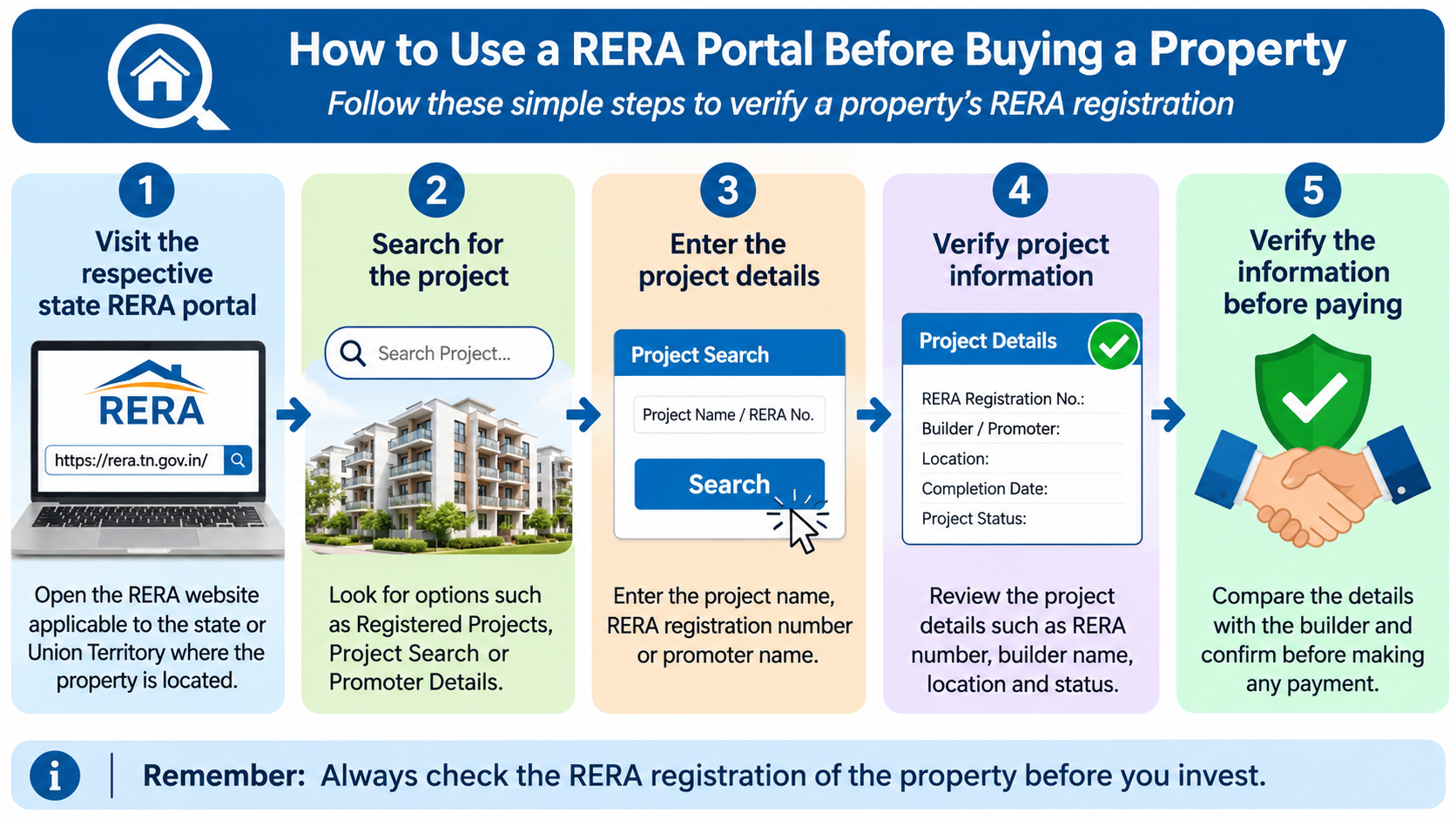
4. How to Use a RERA Portal Before Buying a Property
Checking the RERA registration of a property is an important step before making a purchase decision.
Most state RERA portals provide facilities to search for registered projects, promoters and real estate agents.
Here is a simple process that property buyers can follow.
Step 1: Visit the respective state RERA portal
Open the RERA website applicable to the state or Union Territory where the property is located.
Step 2: Search for the project
Look for options such as:
- Registered Projects
- Project Search
- Promoter Details
- Real Estate Agent Search
Step 3: Enter the project details
Enter the project name, RERA registration number or promoter name, depending on the search facility available.
Step 4: Verify project information
Review the following details:
- RERA registration number.
- Name of the builder or promoter.
- Project location and address.
- Approved project details.
- Proposed completion date.
- Project status and construction updates.
- Available approvals and uploaded documents.
Step 5: Verify the information before paying
Compare the information available on the RERA portal with the details provided by the builder. If you find any differences, seek clarification before proceeding with the purchase.
5. Important Things Every Property Buyer Should Know
Although RERA provides several protections, property buyers should also take responsibility for verifying property-related information.
Here are some important points to remember:
Check RERA registration
Verify whether the project is registered with the appropriate RERA authority. Registration exemptions may apply to certain projects, including those below the statutory size or apartment thresholds.
Verify the builder's details
Check the promoter's registration and previous project information where available.
Review the agreement
Read the agreement for sale carefully, including payment schedules, possession dates and applicable charges.
Check property documents
Independently verify land ownership, title documents, building approvals and other applicable legal documents.
Understand your complaint rights
If the builder violates applicable RERA provisions or fails to fulfil contractual obligations, you may approach the appropriate authority for relief.
Conclusion
RERA has brought significant improvements to India's real estate sector by encouraging transparency, accountability and better protection for property buyers.
It helps buyers access important project information, verify builder details and seek remedies when developers fail to fulfil their legal obligations.
Whether you are purchasing your first home, investing in residential property or buying commercial real estate, checking the applicable RERA portal is an important step before making a decision.
Remember: Before investing your hard-earned money in a property, take time to verify its RERA registration and other legal documents. A little research today can help you avoid major problems in the future.
Disclaimer
The information provided in this article is intended for general educational and informational purposes only. It should not be considered legal, financial or investment advice.
The state-wise RERA portal links have been compiled using publicly available information, including the Ministry of Housing and Urban Affairs (MoHUA). Portal addresses, administrative arrangements, rules and regulations may change from time to time.
Readers are advised to visit the respective official government websites and verify the latest information before making any property-related decisions.
Lunohomes does not guarantee the accuracy, completeness or continued availability of external website links. Property buyers are encouraged to consult qualified legal professionals and independently verify all property-related documents before entering into any transaction.