
Renting a home involves more than paying rent and following the rental agreement. Tenants also need to ensure that their homes remain safe, functional, and suitable for everyday living.
Problems such as leaking taps, damaged electrical fittings, water seepage, blocked drains, and broken locks can occur during a tenancy. When these problems arise, tenants should report them promptly and maintain proper records.
Tenant documentation of maintenance issues means recording the problem, taking photographs where appropriate, informing the landlord or property manager, and tracking the repair until it is completed.
For example, if water starts leaking from a bedroom ceiling, a tenant who keeps dated photographs and written complaint messages can demonstrate when the issue was noticed and how it progressed.
Good documentation helps tenants and landlords communicate clearly, arrange repairs efficiently, and reduce misunderstandings.
1. Why Is Maintenance Documentation Important?
Keeping maintenance records offers several benefits.
- Establishes a timeline: Records show when a problem was first noticed and how it changed.
- Provides proof of communication: Written complaints help demonstrate that the landlord was informed.
- Helps prevent deposit disputes: Move-in photographs and repair records can help distinguish pre-existing defects from damage occurring during the tenancy.
- Supports faster repairs: A clear description and photographs help the maintenance team understand the problem.
- Identifies recurring issues: Records can show when a temporary repair has failed or a problem has returned.
Documentation does not automatically guarantee a particular outcome in a dispute, but it provides useful evidence for discussions and any appropriate grievance process.
2. Which Maintenance Issues Should Tenants Document?
Tenants should document problems that affect the property's condition, safety, or normal use.
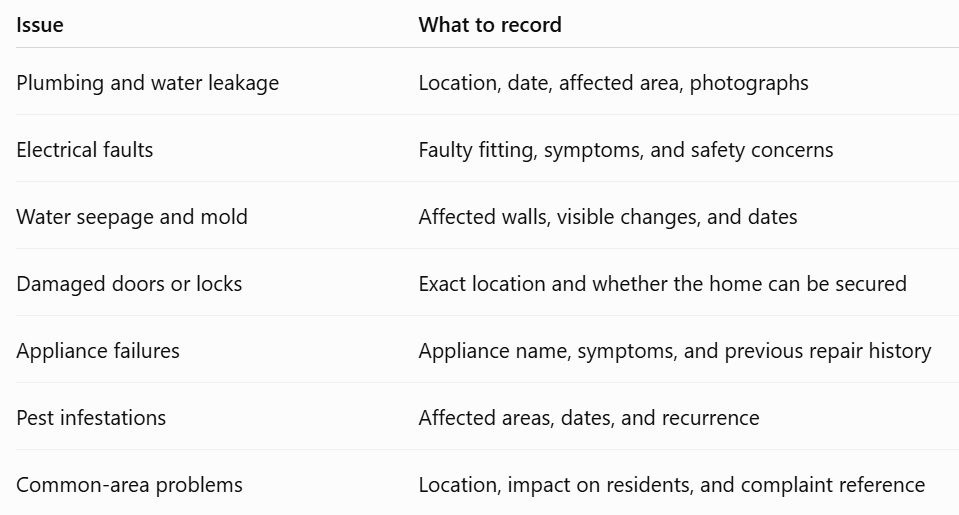
Describe what you observe instead of making unsupported assumptions about the technical cause.
Safety reminder: Exposed wiring, suspected gas leaks, major ceiling damage, and similar hazards require urgent attention. Contact the appropriate emergency or maintenance service first. Never delay necessary safety action to collect evidence.
3. The Maintenance Documentation Workflow
Use this five-step process whenever a maintenance issue arises.
- Identify the problem: Record the date, location, and visible symptoms.
- Collect evidence: Take clear photographs or videos when safe.
- Report in writing: Notify the landlord or property manager and retain a copy.
- Track the repair: Record responses, appointments, and follow-ups.
- Confirm resolution: Check the repair, record the outcome, and note any remaining problems.
The visual workflow infographic accompanying this article illustrates these five steps.
For a recurring problem, continue documenting changes even after a repair has been attempted. A temporary improvement does not necessarily mean the underlying issue has been resolved.
4. What Information Should a Maintenance Record Include?
A maintenance record should be clear enough that the tenant, landlord, or technician can understand the problem without repeatedly asking for the same information.
Include these details:
- Complaint reference number, if available.
- Date and approximate time the issue was noticed.
- Room or area affected.
- Description of the problem and its severity.
- Photographs, videos, or other supporting evidence.
- Date the landlord or property manager was notified.
- Responses, inspection appointments, and repair visits.
- Current status and final resolution notes.
For example, a record might state that water seepage was noticed near the bedroom window on 18 October, photographs were sent to the landlord that day, and an inspection was scheduled for 20 October.
Tenants can maintain these details in a spreadsheet, notebook, email folder, or maintenance application. Keep important records backed up and organized by date.
5. How to Report Maintenance Issues Effectively
A maintenance complaint should be polite, specific, and action-oriented.
A useful written report should include:
- A clear subject line or opening.
- The date and location of the problem.
- A short description of the symptoms.
- Relevant photographs or videos.
- A request for inspection, repair, or an estimated response time.
Email, SMS, WhatsApp, or an official maintenance portal can provide a written record. For urgent problems, contact the landlord or appropriate service directly as well.
Save the complete conversation, including acknowledgements and replies. After a phone call, consider sending a short message confirming what was discussed and any agreed next steps.
6. What Should Tenants Do If Repairs Are Delayed?
Some repairs require inspection, spare parts, or coordination with building management. Nevertheless, tenants should keep track of unresolved problems and request updates when appropriate.
A follow-up should mention the original complaint date, the issue's current condition, any new evidence, and the action requested.
If the problem remains unresolved:
- Review the repair responsibilities in the rental agreement.
- Send a formal written follow-up describing the problem and previous reporting dates.
- Preserve all photographs, messages, acknowledgements, and repair records.
- Check the applicable local tenancy rules and grievance procedures.
- Seek qualified legal advice if the matter involves a serious safety concern, significant financial loss, or a continuing dispute.
Tenants should not automatically withhold rent or deduct repair expenses from rent without checking the applicable agreement and law.
7. Move-In and Move-Out Documentation
Maintenance documentation should begin before moving into the property and continue until the tenancy ends.
Before moving in
- Inspect the walls, ceilings, floors, plumbing, electrical fittings, locks, and supplied appliances.
- Take dated photographs of existing defects.
- Report significant problems in writing and retain the landlord's acknowledgement.
During the tenancy
- Save complaints, repair acknowledgements, inspection details, and photographs.
- Report worsening or recurring problems promptly.
- Keep track of repairs that remain incomplete.
Before moving out
- Photograph the property's condition and compare it with the move-in records.
- Document any outstanding maintenance problems previously reported.
- Retain the final inspection report, handover confirmation, and security deposit communications.
These records help establish the property's condition over time. They do not remove responsibility for damage caused by the tenant, but they can help clarify disagreements about pre-existing defects and ordinary wear and tear.
8. Practical Maintenance Documentation Checklist
Before closing a maintenance complaint, use this checklist:
✓ Record the date and time the issue was noticed.
✓ Describe the problem and its exact location.
✓ Take photographs or videos when safe.
✓ Notify the landlord or property manager in writing.
✓ Save the original complaint and any acknowledgement.
✓ Record inspection appointments and repair visits.
✓ Follow up if the issue remains unresolved.
✓ Verify the repair and document the final outcome.
✓ Keep the records with the rental agreement and other property documents.
Conclusion
Tenant documentation of maintenance issues is a simple habit that can make renting a home more transparent and manageable.
By recording problems promptly, collecting appropriate evidence, communicating in writing, and tracking repairs until completion, tenants can support better maintenance and reduce the risk of misunderstandings.
Landlords also benefit from accurate reports because they help identify defects, arrange suitable repairs, and recognize recurring problems.
The key takeaway: identify the problem, document the evidence, report it clearly, follow up appropriately, and keep a record of the final outcome.
Good documentation is not about creating conflict. It is about encouraging accountability, effective communication, and a well-maintained home.