

The rental housing market in India is changing rapidly. With increasing urbanization, job opportunities in major cities, migration for education and employment, and changing lifestyle preferences, more people are choosing to rent homes instead of purchasing properties.
Cities such as Bengaluru, Chennai, Hyderabad, Pune, Mumbai, Delhi NCR and Coimbatore continue to attract working professionals, students, families and business owners. This has created new opportunities for landlords while also increasing competition among tenants looking for suitable rental homes.
In 2027, the Indian rental market is expected to focus more on transparency, convenience, digital rental agreements, reasonable security deposits, better property maintenance and tenant-friendly facilities.
Whether you are a tenant searching for a rental house in India or a landlord planning to rent out your residential property, understanding these changes can help you make better decisions.
Let's explore the major rental housing trends, rental agreement rules, security deposits, rent increases and landlord responsibilities that tenants and property owners should understand in 2027.
1. Increasing Demand for Rental Properties in Indian Cities
One of the biggest changes in India's rental market is the increasing demand for residential rental properties.
Many people move to different cities for employment, higher education, business opportunities and better living conditions. Buying a property may not be practical for everyone, particularly those who are new to a city or planning to stay for a limited period.
As a result, renting a house has become a convenient option.
Major reasons behind increasing rental demand:
- Job opportunities: IT professionals, employees and business owners frequently relocate to cities for better career opportunities.
- Education: Students prefer rental apartments and shared accommodation near colleges and universities.
- Flexibility: Young professionals often prefer renting because it allows them to relocate easily.
- High property prices: Purchasing a house requires a significant financial commitment, including a down payment and home loan repayments.
- Changing lifestyles: Many families prefer living close to workplaces, schools, hospitals and public transportation.
What should tenants expect?
Tenants may experience greater competition for well-maintained houses in popular residential locations. Properties close to IT parks, educational institutions, metro stations and commercial areas may attract more rental enquiries.
What should landlords expect?
Landlords with well-maintained properties, reasonable rent and essential facilities may find it easier to attract genuine tenants and reduce vacancy periods.
2. Rental Agreements: Why Written Agreements Are Becoming More Important
A rental agreement is one of the most important documents between a landlord and a tenant. It explains the conditions under which a property is rented and helps protect both parties.
In 2027, tenants and landlords should give more importance to written rental agreements instead of depending only on verbal discussions.
A properly prepared rental agreement should clearly mention the following details:
- Name and address of the landlord and tenant.
- Complete address of the rental property.
- Monthly rental amount.
- Security deposit amount.
- Rental agreement duration.
- Rent payment due date.
- Rent increase or escalation conditions.
- Notice period for vacating the property.
- Maintenance charges and utility payment responsibilities.
- Rules regarding property damage and repairs.
Is an 11-month rental agreement compulsory in India?
Many landlords and tenants commonly choose an 11-month rental agreement. However, an 11-month agreement is not compulsory for every rental arrangement in India.
Under the Registration Act, 1908, leases of immovable property from year to year, for a term exceeding one year, or reserving yearly rent generally require registration.
Shorter rental agreements may not require compulsory registration under this particular provision, although state-specific laws, stamp duty requirements and other applicable rules must also be considered.
Tenants and landlords should check the applicable registration and stamp duty requirements in their state before signing an agreement.
Important tip: Always read the rental agreement carefully before signing it. Never depend entirely on verbal promises regarding rent, deposits, repairs or property conditions.
3. Security Deposits: What Tenants and Landlords Should Expect
Security deposits are another important topic in India's rental housing market.
A security deposit is an amount paid by the tenant to the landlord before occupying the property. It generally acts as financial protection against unpaid rent, outstanding bills or damage beyond normal wear and tear, depending on the rental agreement and applicable law.
How much security deposit is normally required?
Security deposit requirements vary depending on the city, property type, landlord and local rental practices.
For example:
- Some landlords may request two months' rent as a security deposit.
- Others may request three to six months' rent.
- In certain rental markets, deposits may be higher depending on local practices.
There is no single nationwide security deposit limit applicable to every residential rental agreement.
The Model Tenancy Act, 2021, provides for a security deposit limit of two months' rent for residential premises. However, its implementation depends on adoption by individual states and Union Territories. Tenants should check the applicable state law rather than assume that this provision automatically applies everywhere.
What should tenants check before paying a security deposit?
- Obtain a written receipt for the deposit payment.
- Mention the exact deposit amount in the rental agreement.
- Understand the conditions under which deductions can be made.
- Confirm when the deposit will be returned after vacating the property.
- Keep proof of payment through bank transfer or other traceable methods.
What should landlords follow?
Landlords should maintain clear records of security deposit payments and deductions. Any deduction should be supported by the rental agreement and relevant evidence.
A transparent security deposit policy can help avoid unnecessary disputes between tenants and landlords.
4. Rent Increases: Will Monthly Rents Become More Expensive in 2027?
Rent increases are a common concern for tenants, particularly in cities where demand for rental properties is high.
In 2026, rental prices may continue to increase in selected residential locations. However, the rate of increase will depend on factors such as property location, demand, available rental supply, infrastructure development and the overall economic situation.
According to Magicbricks' April–June 2026 Rental Index, residential rental values increased by 6.2% year-on-year across the markets covered by its report. However, individual cities and localities experienced different trends.
What are the common reasons for rent increases?
- Increasing demand for rental houses.
- Development of IT parks and commercial areas.
- Improved metro and public transportation facilities.
- Better schools, hospitals and shopping facilities nearby.
- Limited availability of well-maintained rental properties.
- General increases in property maintenance and operating costs.
Can landlords increase rent whenever they want?
No. Landlords and tenants should follow the rent revision conditions mentioned in their rental agreement and applicable state tenancy laws.
For example, if the agreement mentions a 5% annual rent increase, both parties should follow that agreed condition, subject to applicable law.
Landlords should communicate rent revisions in advance rather than suddenly demanding higher rent.
Example of a rental increase
Consider a property with a monthly rent of ₹15,000.
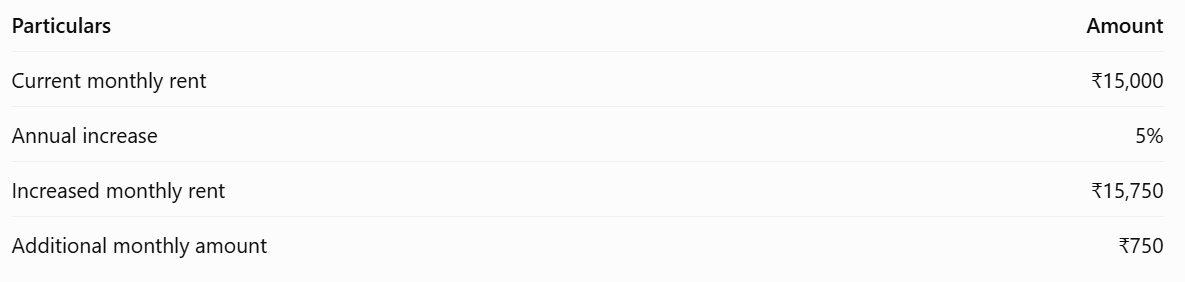
A clear rent escalation clause helps tenants plan their monthly expenses and helps landlords maintain predictable rental income.
5. Changing Tenant Preferences: What Type of Rental Homes Are People Looking For?
Tenant preferences are changing as lifestyles, work arrangements and family requirements evolve.
Earlier, many tenants primarily considered monthly rent and property location. Today, tenants also look at facilities, connectivity, security, maintenance and the overall living experience.
According to Magicbricks' 2026 rental market report, 2 BHK properties accounted for 46% of rental demand, while semi-furnished homes represented 55% of tenant demand.
Some important tenant preferences in 2027 include:
1. Fully furnished and semi-furnished houses
Working professionals and people relocating from other cities often prefer furnished or semi-furnished apartments. Essential furniture, wardrobes, kitchen cabinets and basic appliances can make moving easier.
2. Properties near workplaces
Tenants prefer homes located close to IT parks, business centres and commercial areas to reduce daily travel time.
3. Good connectivity and transportation
Properties near metro stations, bus stops, railway stations and major roads are becoming attractive options.
4. Security and gated communities
Families and working professionals often prefer gated communities with CCTV cameras, security personnel, parking facilities and controlled entry.
5. Internet and work-from-home facilities
With flexible working arrangements continuing in many industries, tenants may prefer homes with reliable internet connectivity, dedicated workspaces and peaceful surroundings.
6. Affordable rental properties
Not every tenant wants a luxury apartment. Many families and young professionals prefer affordable 1 BHK and 2 BHK rental houses with essential facilities.
What does this mean for landlords?
Landlords should understand local tenant requirements before investing in expensive renovations. Providing basic facilities, maintaining the property properly and offering reasonable rental prices can make a property more attractive.
6. Landlord Responsibilities: What Property Owners Should Follow
Renting out a property involves more than collecting monthly rent. Landlords also have responsibilities to ensure that tenants can live comfortably and safely.
In 2027, tenants are increasingly looking for landlords who respond quickly to maintenance requests and maintain transparent rental arrangements.
Some important landlord responsibilities include:
1. Maintaining the property
Landlords should ensure that the property is in a reasonable and habitable condition before handing it over to tenants.
2. Handling major repairs
Major structural issues, plumbing problems and electrical wiring defects should be addressed according to the rental agreement and applicable laws.
3. Respecting tenant privacy
Landlords should not enter rented properties without respecting the tenant's privacy. Property inspections and visits should be arranged with reasonable prior notice, except where an emergency or applicable law provides otherwise.
4. Returning security deposits
Landlords should return the security deposit according to the agreement and applicable law after adjusting legitimate outstanding amounts or documented damage.
5. Providing payment records
Landlords should maintain proper records of monthly rent, security deposits and other payments. Providing receipts helps avoid payment-related disputes.
6. Following legal procedures
Landlords should follow applicable tenancy laws and legal procedures when terminating agreements or seeking possession of their properties.
7. Providing essential facilities
Landlords should ensure that essential services such as water and electricity are available as agreed and that issues affecting basic living conditions are addressed promptly.
A responsible landlord can build a good relationship with tenants, encourage longer stays and reduce frequent property vacancies.
7. Tenant Responsibilities: What Tenants Should Follow
Just as landlords have responsibilities, tenants must also follow certain rules while occupying a rented property.
Some important responsibilities include:
- Pay monthly rent within the agreed due date.
- Maintain the property in good condition.
- Pay electricity, water and maintenance charges according to the agreement.
- Avoid damaging the property intentionally.
- Do not sublet the property without the landlord's required written consent.
- Follow apartment association and community rules.
- Inform the landlord about major repair requirements.
- Provide the agreed notice period before vacating the property.
- Return the property and keys in accordance with the agreed handover conditions.
Tenants should also retain copies of rental agreements, rent payment receipts and security deposit payment records.
Following these basic responsibilities can help tenants maintain a positive relationship with landlords.
8. Digital Rental Agreements and Online Property Search Are Becoming Popular
Technology is changing the way people find rental homes in India.
Earlier, tenants mainly depended on local brokers, newspaper advertisements and personal contacts. Today, online real estate portals make it easier to search for rental properties across different locations.
Some important digital trends include:
- Online rental property listings.
- Digital communication between landlords and tenants.
- Online rent payments through banking applications.
- Digitally prepared and signed rental documents.
- Online tenant verification services.
- Virtual property tours and property photographs.
Digital rental agreements can also make documentation easier. However, electronic signing does not automatically remove applicable stamp duty or registration requirements.
For tenants, online property search saves time and provides more options.
For landlords, digital property listings help reach a larger audience and potentially reduce the time required to find suitable tenants.
Platforms such as Lunohomes can help tenants explore available rental properties and help property owners reach people searching for homes.
9. Important Things Tenants Should Check Before Renting a House in 2027
Before finalizing a rental property, tenants should carefully review the property and rental conditions.
Rental house checklist for tenants
- Verify the landlord's identity and property ownership or authority to rent.
- Inspect the property before paying the deposit.
- Check the monthly rent and security deposit.
- Read the rental agreement carefully.
- Confirm the rent increase conditions.
- Understand the notice period and lock-in period.
- Check maintenance charges and electricity or water bills.
- Take photographs of the property's condition before moving in.
- Confirm parking, water supply and security facilities.
- Keep payment receipts and a signed copy of the agreement.
10. What Should Landlords Do to Attract Good Tenants in 2027?
Landlords should understand that rental property management is becoming more competitive.
Simply owning a residential property may not be enough to attract quality tenants. Property owners should focus on providing good facilities, maintaining reasonable rental prices and ensuring a smooth rental experience.
Here are some practical suggestions:
- Keep the property well-maintained: Repair leaking taps, electrical issues, damaged doors and other problems before listing the property.
- Set a competitive rental price: Compare similar properties in the same locality before deciding the monthly rent.
- Provide clear property photographs: Good-quality photographs help tenants understand the property's condition.
- Offer flexible furnishing options: Consider providing essential furniture and appliances based on local tenant demand.
- Prepare a proper rental agreement: Clearly mention rent, deposit, notice period and maintenance responsibilities.
- Verify tenants appropriately: Follow lawful and proportionate identity and background verification procedures.
- Respond to tenant requests: Timely communication and maintenance support can encourage tenants to continue renting the property.
- Avoid unreasonable rent increases: Reasonable rent revisions can help retain reliable tenants for longer periods.
A good rental experience benefits both landlords and tenants.
11. Future of India's Rental Housing Market: What Can We Expect?
The Indian rental housing market is expected to become more organized, technology-driven and customer-focused over the coming years.
Some important developments to watch include:
- More formal rental agreements: Written agreements and proper documentation are likely to become increasingly important.
- Better tenant protection: State-level tenancy regulations may improve transparency and provide clearer procedures for resolving disputes.
- Professional property management: More landlords may use property management companies to handle tenant enquiries, rent collection and maintenance.
- Growth of co-living spaces: Students and working professionals may increasingly consider shared accommodation and managed rental properties.
- Increasing demand for quality homes: Tenants may prefer properties offering good connectivity, security and essential facilities.
- Digital rental platforms: Online property portals may play a bigger role in connecting landlords with genuine tenants.
The Model Tenancy Act, 2021, provides a framework for improving India's rental housing ecosystem. However, it is important to remember that rental laws differ between states, and the Model Act does not automatically apply nationwide. Tenants and landlords should check the laws applicable to their property location.
Conclusion
The rental housing market in India is changing, creating new opportunities and challenges for both tenants and landlords.
For tenants, the focus should be on finding affordable homes, understanding rental agreements, protecting security deposits and knowing their legal rights.
For landlords, maintaining properties, setting reasonable rents, preparing transparent agreements and providing good tenant services will become increasingly important.
In 2027, successful rental arrangements will depend on transparency, proper documentation, mutual respect and clear communication between both parties.
Whether you are searching for a rental house in India or planning to rent out your residential property, staying informed about rental market trends can help you make better property decisions.
At Lunohomes, we aim to make property searching easier by helping tenants explore rental properties and connecting property owners with potential tenants.
Disclaimer
This article is published for general informational and educational purposes only. Rental laws, security deposit limits, registration requirements and other tenancy rules may differ across Indian states and Union Territories. Readers are advised to verify the latest applicable local regulations or consult a qualified legal professional before entering into a rental agreement. Lunohomes does not provide legal advice.