

Buying a home is one of the biggest financial decisions in a person's life. Whether you are planning to purchase an apartment, an independent house, a villa, or a plot of land, you will come across many real estate terms during the buying process.
Terms such as RERA, Carpet Area, Super Built-up Area, Encumbrance Certificate, Sale Deed, and Occupancy Certificate may sound complicated, especially for first-time homebuyers.
Understanding these terms can help you make better decisions, avoid confusion, identify potential risks, and complete your property purchase with confidence.
In this article, let's explore the top 20 commonly used real estate terms in India in simple and easy-to-understand language.
Top 20 Real Estate Terms Every Homebuyer Should Know
1. RERA (Real Estate Regulatory Authority)
RERA stands for Real Estate Regulatory Authority. It was introduced under the Real Estate (Regulation and Development) Act, 2016, to improve transparency and protect the interests of property buyers.
RERA regulates real estate projects and real estate agents in India.
Why is it important?
- Helps protect homebuyers against unfair practices.
- Requires eligible projects to be registered with the respective state RERA authority.
- Provides information about project approvals, construction progress, and delivery timelines.
- Provides a mechanism for buyers to raise complaints.
Example: Before purchasing an apartment in Chennai, you can check whether the project is registered with Tamil Nadu RERA (TNRERA).
2. Carpet Area
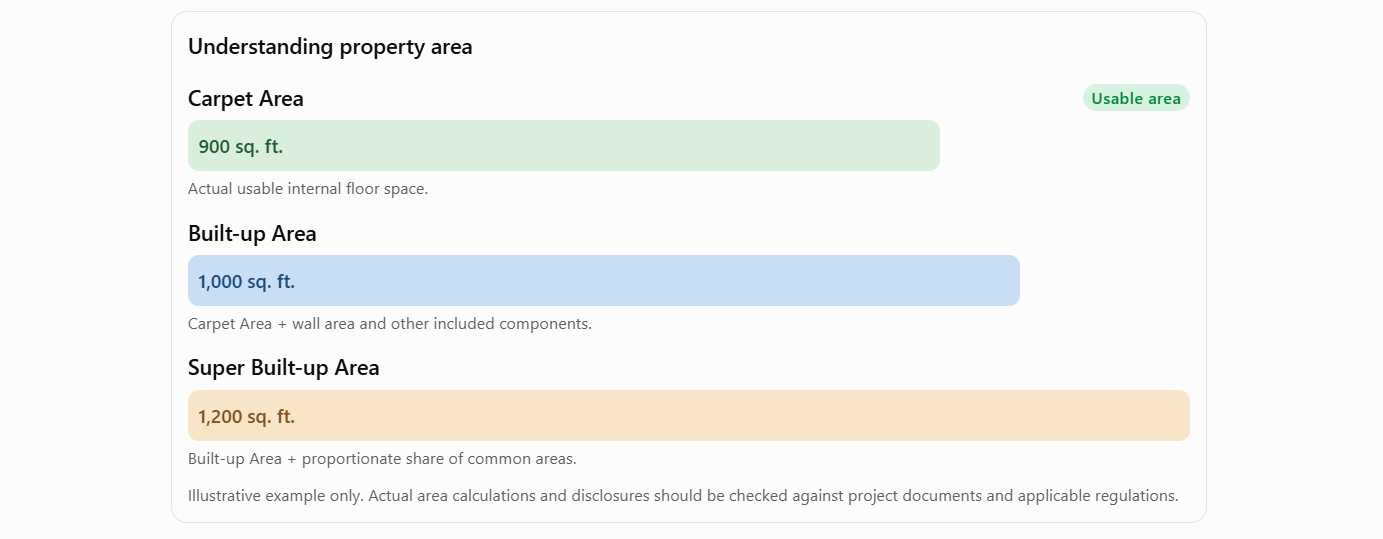
Carpet Area refers to the actual usable floor area inside an apartment, where you can place furniture, walk around, and use the space.
Under RERA, carpet area generally excludes external walls, service shafts, exclusive balcony or verandah areas, and exclusive open terrace areas. Internal partition walls are included.
Example:
If an apartment has a carpet area of 900 sq. ft., it means you have approximately 900 sq. ft. of usable internal floor space as defined under RERA.
Why is it important?
Carpet Area helps you understand how much usable space you are actually purchasing.
3. Built-up Area
Built-up Area includes the Carpet Area plus the area occupied by internal and external walls and other components included in the built-up measurement. Built-up Area is generally larger than Carpet Area.
4. Super Built-up Area
Super Built-up Area includes the Built-up Area along with a proportionate share of common areas such as:
- Corridors
- Lifts and lift lobbies
- Staircases
- Common facilities and shared spaces
It is sometimes referred to as the saleable area.
Example:
If an apartment has a Built-up Area of 1,000 sq. ft. and an allocated common-area share of 200 sq. ft., its Super Built-up Area is 1,200 sq. ft.
Why is it important?
Always compare properties based on Carpet Area, not just Super Built-up Area, to understand the actual usable space.
5. Agreement for Sale
An Agreement for Sale is a legal document signed between the property buyer and the seller or builder before the final transfer of ownership.
It generally contains details such as:
- Property price and payment schedule.
- Property specifications and area.
- Construction and possession timelines.
- Rights and responsibilities of both parties.
- Terms and conditions for cancellation or delay.
Example: When you book an under-construction apartment, the builder and buyer generally enter into an Agreement for Sale outlining the terms of the purchase.
6. Sale Deed
A Sale Deed is the legal document that records the transfer of ownership of a property from the seller to the buyer.
It is generally executed and registered with the relevant Sub-Registrar Office after the applicable stamp duty and registration charges are paid.
Why is it important?
A registered Sale Deed is one of the most important documents establishing your ownership of a property.
7. Encumbrance Certificate (EC)
An Encumbrance Certificate is a document issued by the registration department that provides information about registered transactions and certain registered encumbrances relating to a property for a specified period.
It can help buyers identify registered mortgages, sales, and other recorded transactions.
Example: Before purchasing a resale property, you may request an EC for the previous 15 or 30 years, depending on the property and legal advice.
Why is it important?
It helps you check the property's registered transaction history. However, an EC alone does not establish that a property has a clear title or that there are no outstanding liabilities.
8. Occupancy Certificate (OC)
An Occupancy Certificate is issued by the competent local authority after confirming that a building complies with applicable requirements for occupation.
It generally indicates that the building is permitted to be occupied under the relevant regulations.
Why is it important?
Before taking possession of a completed apartment, check whether the required Occupancy Certificate has been obtained.
9. Completion Certificate (CC)
A Completion Certificate is issued by the competent authority after verifying that the building has been constructed in accordance with the approved building plan and applicable requirements.
Simple difference:
- CC: Confirms completion of construction as per applicable approvals.
- OC: Confirms that the building is fit or permitted for occupation under applicable regulations.
These certificates may be issued separately, depending on local rules.
10. Stamp Duty
Stamp Duty is a government tax payable on certain property transactions and legal documents, such as Sale Deeds.
The applicable stamp duty rate varies depending on the state, property value, property type, and other applicable factors.
Example: If you purchase a property worth ₹50 lakh, you may need to pay stamp duty based on the applicable state rules.
Why is it important?
Stamp duty is a major additional expense that homebuyers should include in their property purchase budget.
11. Registration Charges
Registration Charges are the fees paid to the government for officially registering property documents, such as a Sale Deed.
Registration creates an official public record of the property transaction.
Example: If you purchase a property for ₹50 lakh, you must pay the applicable registration charges in addition to stamp duty.
Important: Registration charges and stamp duty are two different expenses. Both should be considered when calculating the total property purchase cost.
12. Guideline Value (Circle Rate)
Guideline Value is the minimum property value determined by the state government for registration and stamp duty purposes. It is also known as Circle Rate or Ready Reckoner Rate in some states.
Example:
Suppose:
- Actual property selling price: ₹50 lakh
- Government guideline value: ₹45 lakh
The applicable stamp duty calculation generally considers the higher of the transaction value and the government-determined value, subject to the relevant state rules.
Why is it important?
Before purchasing a property, check the guideline value in the respective state's registration department.
13. Home Loan
A Home Loan is a financial loan provided by a bank or housing finance company to help individuals purchase, construct, or sometimes renovate a residential property.
The borrower repays the loan through monthly instalments over an agreed period.
Example:
If you purchase a house worth ₹60 lakh and contribute ₹15 lakh from your savings, you may need a home loan of ₹45 lakh, subject to the lender's eligibility assessment.
14. LTV (Loan-to-Value Ratio)
LTV stands for Loan-to-Value Ratio. It represents the percentage of the property's eligible value that a lender is willing to finance through a loan.
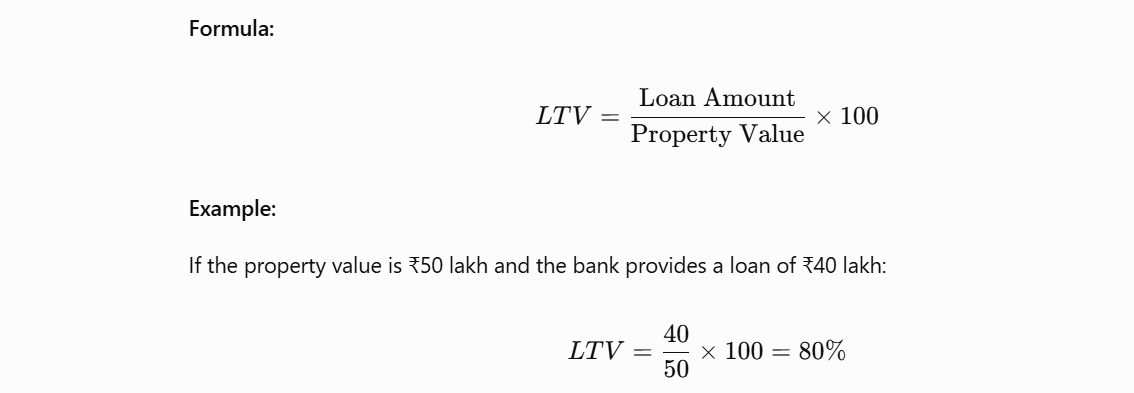
This means the bank is financing 80% of the property value.
The applicable lending limits depend on RBI regulations, the loan category, and the lender's assessment.
15. EMI (Equated Monthly Instalment)
EMI stands for Equated Monthly Instalment. It is the fixed monthly payment a borrower makes towards repaying a home loan.
An EMI generally consists of two components:
- Principal: The amount borrowed from the bank.
- Interest: The amount charged by the lender for providing the loan.
Example:
If you take a home loan of ₹40 lakh for 20 years at an illustrative interest rate of 8.5% per annum, your approximate monthly EMI would be ₹34,713.
Actual EMI depends on the loan amount, interest rate, repayment period, and lender's terms.
16. Down Payment
Down Payment is the initial amount paid by the buyer from their own funds when purchasing a property.
17. Possession
Possession refers to the stage when the buyer receives the right to occupy and use the purchased property, subject to the agreement and applicable legal requirements.
For an under-construction property, possession is generally handed over after construction is completed and the required approvals and certificates are obtained.
Example: If a builder promises to deliver an apartment by December 2027, the buyer should check the agreed possession date in the Agreement for Sale.
Why is it important?
Always verify the possession timeline, delay-related clauses, and required occupancy approvals before making a purchase.
18. Allotment Letter
An Allotment Letter is a document issued by a builder or developer confirming that a particular property or apartment has been allotted to a buyer.
It generally includes:
- Buyer's details.
- Project and apartment details.
- Property area and unit number.
- Total consideration.
- Payment schedule.
- Other applicable conditions.
Example: After booking an apartment and completing the required initial payment, the builder may issue an Allotment Letter confirming the apartment allocated to you.
Important: An Allotment Letter is not a substitute for a registered Sale Deed or the other legal documents required to establish ownership.
19. Mutation of Property
Mutation refers to updating the ownership-related details in the local municipal or revenue records after a property transaction or change in ownership.
It helps ensure that property tax and relevant government records reflect the new owner's details.
Example: After purchasing a house, you may need to apply to the local municipal authority to update the property tax records in your name.
Why is it important?
Mutation helps maintain updated government records. However, mutation by itself does not establish legal ownership or replace a registered title document.
20. UDS (Undivided Share of Land)
UDS stands for Undivided Share of Land. It represents the proportionate share of the total land on which an apartment building is constructed that belongs to an individual apartment owner.
In apartment projects, buyers generally own their individual apartments along with an undivided share of the common land.
Example:
Suppose an apartment project is constructed on 10,000 sq. ft. of land and has 10 apartments of equal entitlement.
Each apartment owner may receive an undivided share of 1,000 sq. ft., subject to the project's legal documents and allocation.
Why is it important?
UDS is particularly important when purchasing apartments in India because the land share is an important component of the property's ownership and long-term value.
Quick Comparison: Important Property Area Terms
Many homebuyers get confused between Carpet Area, Built-up Area, and Super Built-up Area. Here is a simple comparison.
Important Documents to Check Before Buying a Property
Understanding real estate terms is useful, but checking the right documents is equally important.
Here is a simple checklist that every homebuyer should consider before purchasing a property:
- RERA registration details, wherever applicable.
- Parent documents and previous Sale Deeds.
- Encumbrance Certificate (EC).
- Approved building plan and layout approval.
- Completion Certificate (CC), wherever applicable.
- Occupancy Certificate (OC), wherever applicable.
- Property tax receipts.
- Agreement for Sale.
- Sale Deed and registration details.
- Home loan and outstanding mortgage details, if applicable.
Tip: Consider consulting an independent property lawyer to verify the ownership history, title, approvals, and legal status before paying a large advance or signing the final documents.
Conclusion
Buying a property becomes much easier when you understand the common real estate terms used by builders, banks, property agents, and government authorities.
Before finalising your property purchase, make sure you understand the property's actual Carpet Area, legal ownership, RERA registration, applicable government charges, and possession conditions.
Remember, a property purchase is not just about finding a home within your budget. It is equally important to ensure that the property is legally safe and offers good value for your investment.
A little knowledge before buying a property can help you avoid major problems in the future!
Disclaimer
This article is intended for general educational and informational purposes only. The information provided should not be considered legal, financial, or investment advice. Real estate rules, taxes, registration charges, and regulations may vary from state to state in India. Buyers are advised to verify all property-related documents and consult qualified legal and financial professionals before making any property purchase.