

Real estate has long been a popular investment choice in India. Many people invest in residential properties such as apartments, independent houses, and villas to earn rental income or benefit from property price appreciation.
However, buying a property requires a significant amount of money. Investors must also manage tenants, arrange repairs, pay maintenance expenses, and handle other responsibilities.
Is there a way to invest in real estate without purchasing an entire property?
Yes, one option is a Real Estate Investment Trust (REIT).
A REIT allows investors to participate in income-generating real estate through an investment structure. Instead of buying and managing a property themselves, investors purchase units in a trust that owns or invests in real estate assets.
Residential properties can be divided into two broad categories:
- Single-family residential properties: Independent houses or individual homes rented to households.
- Multifamily residential properties: Residential buildings or communities containing multiple separate homes or apartments that are rented to different households.
Residential REITs based on these property types are well established in some international markets. In India, however, investors need to understand an important distinction: the listed REIT market has primarily focused on commercial real estate, and direct exposure to residential rental properties through a listed REIT is not as established.
Let us understand these investment types and how they relate to the Indian market.
1. What Is a Residential REIT?
A Residential Real Estate Investment Trust is an investment structure that owns, operates, or invests in residential properties that generate rental income.
The properties may include apartments, independent houses, or residential communities.
The REIT collects rent from tenants and uses the money to pay operating expenses, property management costs, interest, and other obligations. The remaining income may be distributed to investors, subject to the trust's structure and applicable rules.
How does a residential REIT work?
Imagine a company owns 500 rental apartments in different locations. Instead of requiring one investor to purchase the entire portfolio, the company establishes an investment structure that allows multiple investors to participate.
Investors contribute money by purchasing units or shares, depending on the structure. Rental income from the apartments helps support the investment's returns.
The investor does not normally select individual tenants, collect rent personally, or arrange everyday repairs.
The basic process is simple:
- A REIT or property-owning entity acquires residential properties.
- The properties are rented to individuals and families.
- Tenants pay monthly rent.
- The property manager handles maintenance and tenant-related activities.
- After expenses and obligations, available income may be distributed to investors.
- Investors may also benefit if the value of their investment increases, although losses are possible.
The amount an investor earns depends on the properties, occupancy levels, expenses, financing, market conditions, and the investment's legal structure.
2. What Is a Single-Family Residential REIT?
A Single-Family Residential REIT invests in individual homes that are rented to tenants.
These homes may include independent houses, villas, or detached homes. In markets such as the United States, some large residential property companies own thousands of individual rental houses spread across different neighbourhoods and cities.
Each house is generally occupied by one household.
Example
Imagine a property investment company owns 1,000 independent houses. Each house is rented to a family under a rental agreement.
The company collects rent from all occupied houses. It also pays for property maintenance, insurance where applicable, management, taxes, and other operating expenses.
An investor purchasing units in the investment structure can participate in the overall portfolio rather than purchasing one complete house.
How does it generate income?
Single-family residential REITs may generate returns through:
- Monthly rental income from individual houses.
- Higher rental income when leases are renewed at higher rates, where market conditions permit.
- Property value appreciation over time.
- Efficient management of a large portfolio of rental homes.
However, income is not guaranteed. Vacant homes, unpaid rent, repairs, higher borrowing costs, and falling property values can reduce returns.
Where could this model fit in India?
India has a substantial market for independent houses and villas, particularly in suburban areas and growing cities.
For example, an investor may rent out an independent house in Chennai, Coimbatore, Bengaluru, or Hyderabad. A company could also manage a portfolio of similar rental homes.
This is a useful illustration of the single-family rental business model. It does not mean that a listed Indian REIT currently offers direct exposure to such a portfolio.
3. What Is a Multifamily Residential REIT?
A Multifamily Residential REIT invests in buildings or residential communities containing multiple separate homes or apartments.
These properties may include apartment complexes, large residential buildings, or professionally managed rental communities.
Each apartment can be rented to a different household. The property owner earns income from many tenants within the same building or community.
Example
Imagine a residential building contains 200 apartments. Each apartment is rented to a separate household.
Instead of owning one independent house, the property-owning company manages the entire building and collects rent from many apartments.
An investor can participate in the investment structure without buying an individual apartment.
How does it generate income?
Multifamily residential REITs may earn money through:
- Monthly rent from multiple apartments.
- Rental increases when supported by market conditions and applicable tenancy rules.
- Additional permitted income from parking, amenities, or other property services.
- Property value appreciation.
A large apartment building can benefit from professional management and shared maintenance services. However, it also involves costs such as security, lifts, plumbing, common-area maintenance, repairs, and property management.
Where could this model fit in India?
India has many apartment complexes in cities such as Bengaluru, Pune, Hyderabad, Chennai, Mumbai, and Gurugram.
A company that owns and rents out a complete apartment building would be following a multifamily rental property model.
For example, a company may own 300 rental apartments in Bengaluru and lease them to working professionals and families. The combined rent from these apartments could support the property's operating costs and investment returns.
Again, this illustrates the business model rather than identifying an existing listed Indian residential REIT.
4. Single-Family vs Multifamily Residential REITs
Although both investment types focus on rental housing, their property portfolios are different.
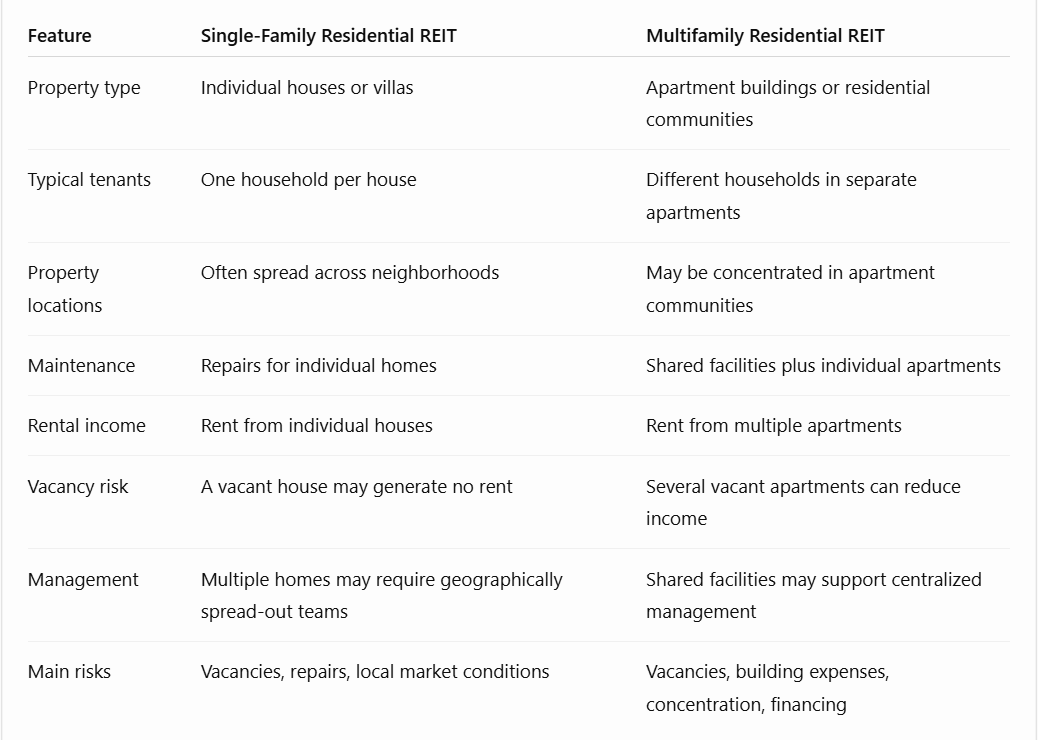
Neither model is automatically better. The investment outcome depends on purchase prices, rental demand, operating expenses, debt, location, and the quality of management.
5. How Do These REITs Work in India?
This is the most important part for Indian investors.
India has a regulated REIT framework overseen by the Securities and Exchange Board of India (SEBI). Listed Indian REITs have historically focused mainly on income-producing commercial real estate, such as office buildings and business parks.
Residential rental REITs are a different investment category. A company owning apartment buildings does not automatically qualify as a listed REIT, and buying shares in a real estate company is not the same as buying units in a REIT.
In India, investors should distinguish between the following options:
A. Listed REITs
Investors can buy units of listed REITs through a demat and trading account, subject to the applicable market and broker requirements.
The REIT owns or invests in eligible real estate assets and may distribute income to unit holders.
However, investors should examine the actual portfolio before investing. A commercial REIT that owns office buildings is not a residential REIT merely because it is involved in real estate.
B. Direct residential property investment
An individual can purchase a house or apartment and rent it to tenants.
This gives the investor direct exposure to residential rental income, but it requires capital for the property, transaction costs, maintenance, and ongoing management.
C. Real estate company shares
Some companies develop, own, or manage residential properties. Investors may buy shares in these companies if they are publicly listed.
However, these shares represent ownership in a business, not direct ownership of a specific residential rental portfolio. Returns may depend on development sales, debt, business performance, and other activities in addition to rental income.
D. Private property investment structures
Some private investment arrangements may pool money from multiple investors to acquire property. Their legal form, regulation, liquidity, fees, and risks can differ significantly.
Investors should verify the structure and applicable regulatory requirements before contributing money. A pooled property investment should not be assumed to be a SEBI-regulated REIT.
6. How Can Indian Investors Earn Returns?
Residential property investments can generate returns in two main ways.
1. Rental income
Rent received from tenants can contribute to the investment's income after expenses.
For example, consider a hypothetical residential property portfolio with annual rent of ₹1 crore. If operating expenses are ₹30 lakh, the remaining amount before financing costs, taxes, and other obligations is ₹70 lakh.
This is not necessarily the amount available for distribution to investors. Further expenses and obligations may apply.
2. Property value appreciation
Property values may increase over time because of infrastructure development, employment growth, improved connectivity, or higher demand for housing.
However, prices can also stagnate or fall. Appreciation is not guaranteed, and selling a property may take time.
Illustrative rental-income example
Suppose a company owns 100 rental apartments. Each apartment earns ₹20,000 per month when occupied, and the average occupancy rate is 95%.
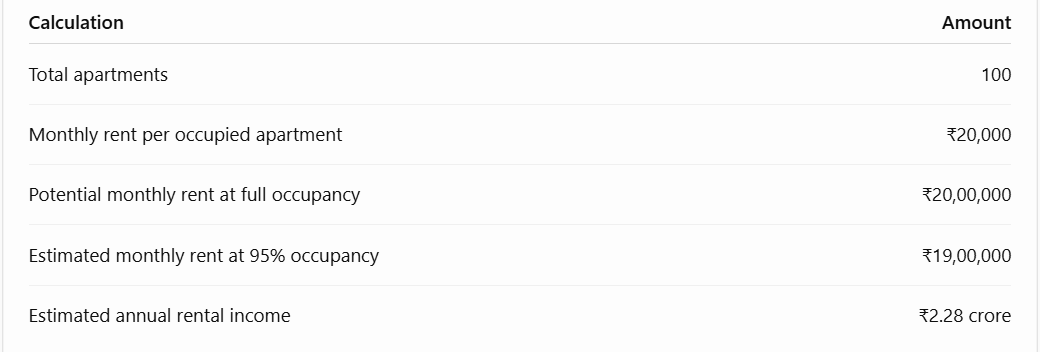
These figures are hypothetical and assume a constant rent and occupancy rate. They exclude maintenance, property taxes, insurance, management fees, financing costs, taxes, and other expenses.
The example demonstrates why occupancy matters: even a large property portfolio may earn less than its full potential when some apartments remain vacant.
7. Benefits of Residential Rental Property Investments
Residential rental investments can offer several potential benefits.
- Recurring income: Rent can provide a regular source of revenue.
- Housing demand: People need homes, creating demand for rental accommodation in suitable locations.
- Portfolio diversification: Residential property exposure may diversify an investor's holdings, although diversification benefits depend on the rest of the portfolio.
- Professional management: A well-managed property portfolio can reduce the everyday burden on individual investors.
- Potential appreciation: Property values may increase over the long term.
- Access to a broader portfolio: Where an appropriate investment structure is available, investors may participate in multiple properties without purchasing each property themselves.
The actual benefits depend on the specific investment. A residential property is not automatically profitable just because it is rented out.
8. Risks Investors Should Understand
Residential property investments also involve risks.
Vacancy risk: Apartments or houses may remain empty between tenants.
Maintenance costs: Repairs, repainting, plumbing, lifts, and other services can reduce income.
Tenant-related risks: Delayed rent payments, disputes, and property damage can affect returns.
Interest-rate risk: Borrowing costs may rise, reducing the income available after debt payments.
Market risk: Property prices and rents can decline in some locations.
Liquidity risk: Selling a physical property can take time. Units in a listed REIT may be easier to trade, but their market prices can fluctuate and liquidity is not guaranteed.
Regulatory and tax risks: Rules concerning property ownership, tenancy, REITs, and taxation can affect returns.
Concentration risk: An investment heavily dependent on one city, building, or tenant group may be more vulnerable to local problems.
Investors should review the legal structure, property portfolio, financial statements, debt levels, fees, and distribution policy before investing.
9. How Should Beginners Evaluate a Residential Property Investment?
Before investing, consider these practical questions:
- What does the investment actually own? Check whether the portfolio contains independent houses, apartments, commercial buildings, or a mixture.
- How much rental income does it generate? Look at actual income rather than relying only on projected returns.
- What is the occupancy rate? Frequent vacancies may indicate weak demand or management issues.
- What are the operating costs? Maintenance, insurance, taxes, management, and financing can significantly affect profitability.
- How much debt does the business have? High debt can increase risk when interest rates rise or rental income falls.
- How easily can you exit? Consider whether the investment is listed, privately held, or a physical property.
- What taxes and fees apply? Review the current rules and the costs associated with buying, holding, and selling the investment.
- Is the investment regulated? Verify the legal structure and any required registrations instead of relying solely on marketing claims.
Beginners should also avoid assuming that high advertised rental yields mean high net returns.
Conclusion
Single-family and multifamily residential REITs offer two different ways to organise investments in rental housing. Single-family REITs focus on individual houses, while multifamily REITs focus on apartment buildings or residential communities containing multiple homes.
Both models aim to generate rental income and may benefit from property value appreciation. However, both face risks related to vacancies, maintenance, operating costs, financing, and market conditions.
For Indian investors, the key distinction is that residential rental property investment is not the same as investing in a listed Indian REIT. India's listed REIT market has primarily focused on commercial real estate, so investors should verify the actual assets held by any investment they are considering.
Understanding the property type, rental income, expenses, regulations, and risks can help investors make more informed decisions about real estate.
Disclaimer: This article is for educational purposes only and is not investment, legal, or tax advice. Property investments can lose value, and rental income is not guaranteed. Verify current SEBI rules, investment documents, and tax requirements before making an investment.